The Unclaimed Answer: The Cheapest Win in AI Visibility
An unclaimed answer is a specific buyer question in your category that no brand has clearly claimed, so the AI assistant hedges or names whichever brand happened to state the attribute in plain language. They are almost always attribute questions one level below the headline category question, like no stevia, safe for kids, or reef safe. The competition for them is near zero and the buyers who ask them are high intent, which makes them the cheapest win in AI visibility. Find the ones your product genuinely satisfies, then state that attribute in plain, extractable language on a page the models read.
Most brands pour their AI visibility effort into the biggest question in their category, the one every competitor is already fighting over. Meanwhile a smaller question sits open a level down, a real shopper is typing it into ChatGPT right now, and no brand has bothered to answer it well. That open question is the cheapest win in AI visibility, and most brands walk right past it.
Here is what an unclaimed answer looks like, a real example of one being taken, and how to find the ones still sitting open in your own category.
What an unclaimed answer is
An unclaimed answer is a real buyer question where the AI has no confident, well-supported brand to name. These are almost never the headline question in a category. They are the attribute questions that sit one layer down: no stevia, no seed oils, safe for kids, lowest sugar, fragrance free, reef safe. A subset of shoppers cares intensely about exactly one of these, they ask the assistant directly, and in most categories the assistant gives a soft answer because no brand has published the attribute in language a model can lift.
That soft answer is the opening. When an assistant hedges, it is telling you the question is still up for grabs.
A real example: the stevia-free soda question
The clearest example we have run is a single question about prebiotic soda. We asked ChatGPT, "is there a prebiotic soda that doesn't use stevia?" A lot of people cannot stand stevia and shop specifically to avoid it, so this is a real question with real buyers behind it.
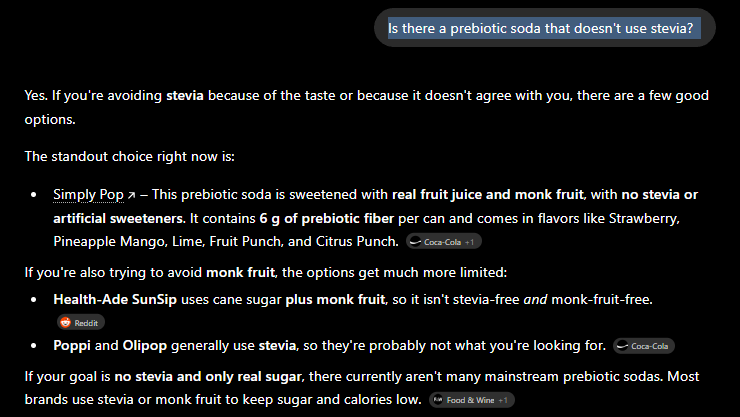
The answer had no hedging. ChatGPT named one brand as "the standout choice right now": Simply Pop, which is Coca-Cola's prebiotic soda. It then went out of its way to disqualify the two category leaders by name, noting that Poppi and Olipop "generally use stevia, so they're probably not what you're looking for." The citations under the answer pointed to Coca-Cola's own product pages, plus Reddit and a food publication.
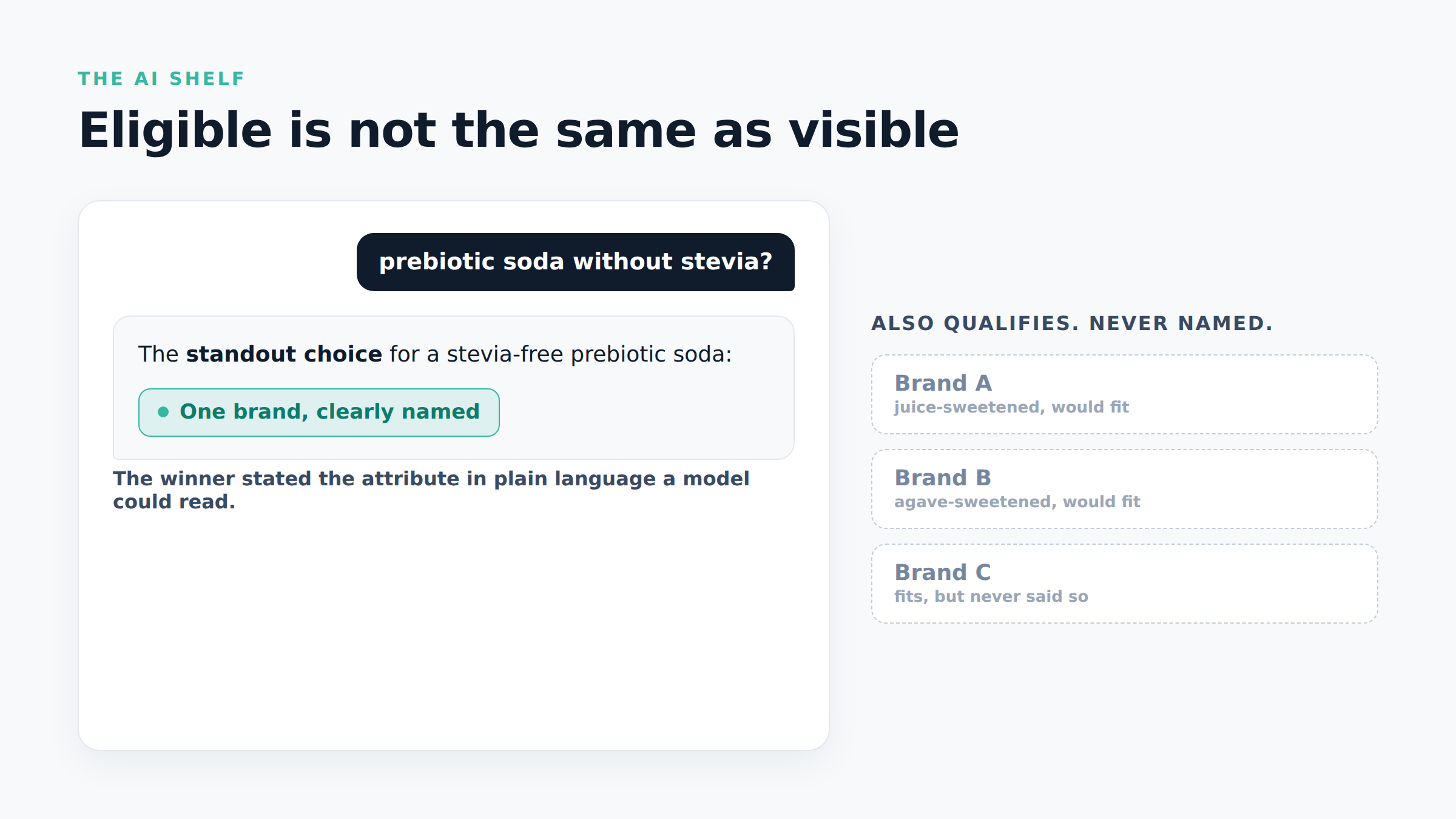
Now look at who was missing. One question earlier, the same assistant had described other brands in the category as fruit-juice sweetened and agave sweetened, brands that sound like they would qualify for a no-stevia answer. They did not appear in this one at all. They were eligible. They were not visible.
Why the biggest brands lose these questions
The biggest brands lose unclaimed answers because category leadership does not transfer to attribute questions. Poppi and Olipop own the general "best prebiotic soda" answer. On the narrower stevia question, their size bought them nothing, and their sweetener choice actively worked against them. The assistant scored the question on its own terms, not on brand fame.
This is the rule underneath the example: eligibility is not visibility. A product can genuinely be the right answer and still lose the question, because nothing it published told the machine so. Coca-Cola did not win the stevia answer with ad spend. It won by stating its sweetener system in plain, specific language on a page the model could read, so when the question came up, Simply Pop was the brand with a clean, quotable claim attached to it. The full teardown of that category is in The AI Shelf: Who Wins When Shoppers Ask AI What to Buy.
Why unclaimed answers are the cheapest win
Unclaimed answers are the cheapest win because the competition for them is close to zero and the fix is entirely in your hands. Three things line up at once:
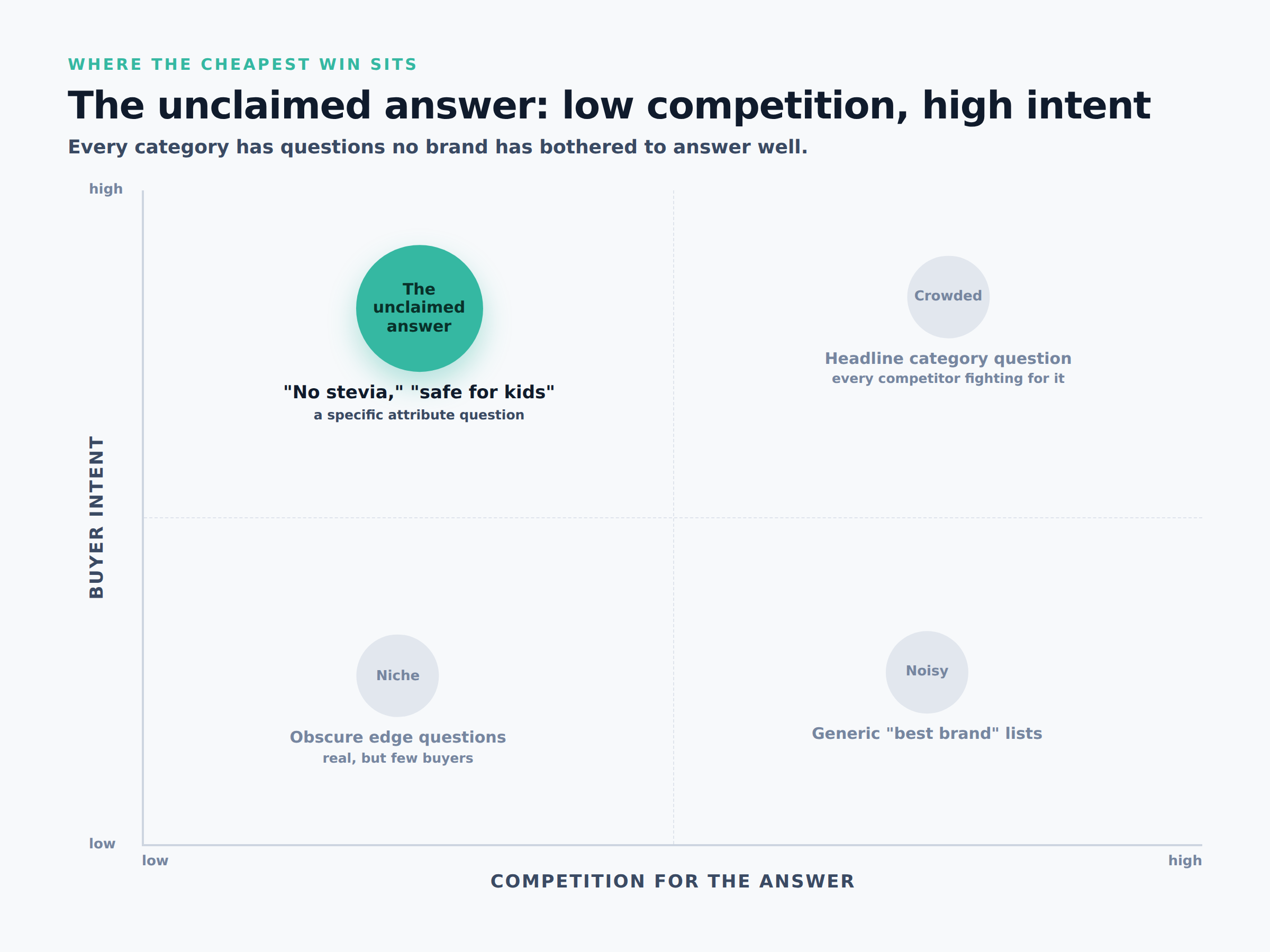
1. Almost no one is contesting them. The big brands are spending on the headline question. The narrow attribute question has no incumbent, so there is no authority to displace, only a gap to fill.
2. The buyers are high-intent. Someone who types "prebiotic soda without stevia" is not browsing, they are qualifying. They have already decided what they want and are asking the assistant to hand them the shortlist. Being the name on that shortlist is worth more than a broad impression.
3. You own the fix. The lever is your own product page and the plain-language claim on it, not a six-month campaign to become famous. The same pattern shows up across categories. In facial sunscreen, small brands like COOLA and Colorescience earn real visibility by owning one attribute each, reef safe and mineral based, while far bigger names show up less because the content about them is general. One clear, well-supported claim beats broad recognition on a specific question. The wider version of that pattern is in GEO vs. AEO vs. AIO vs. SEO: A Guide for CPG Brands.
How to find your category's unclaimed answers
Finding your unclaimed answers is a specific exercise, not a guess. Four steps:
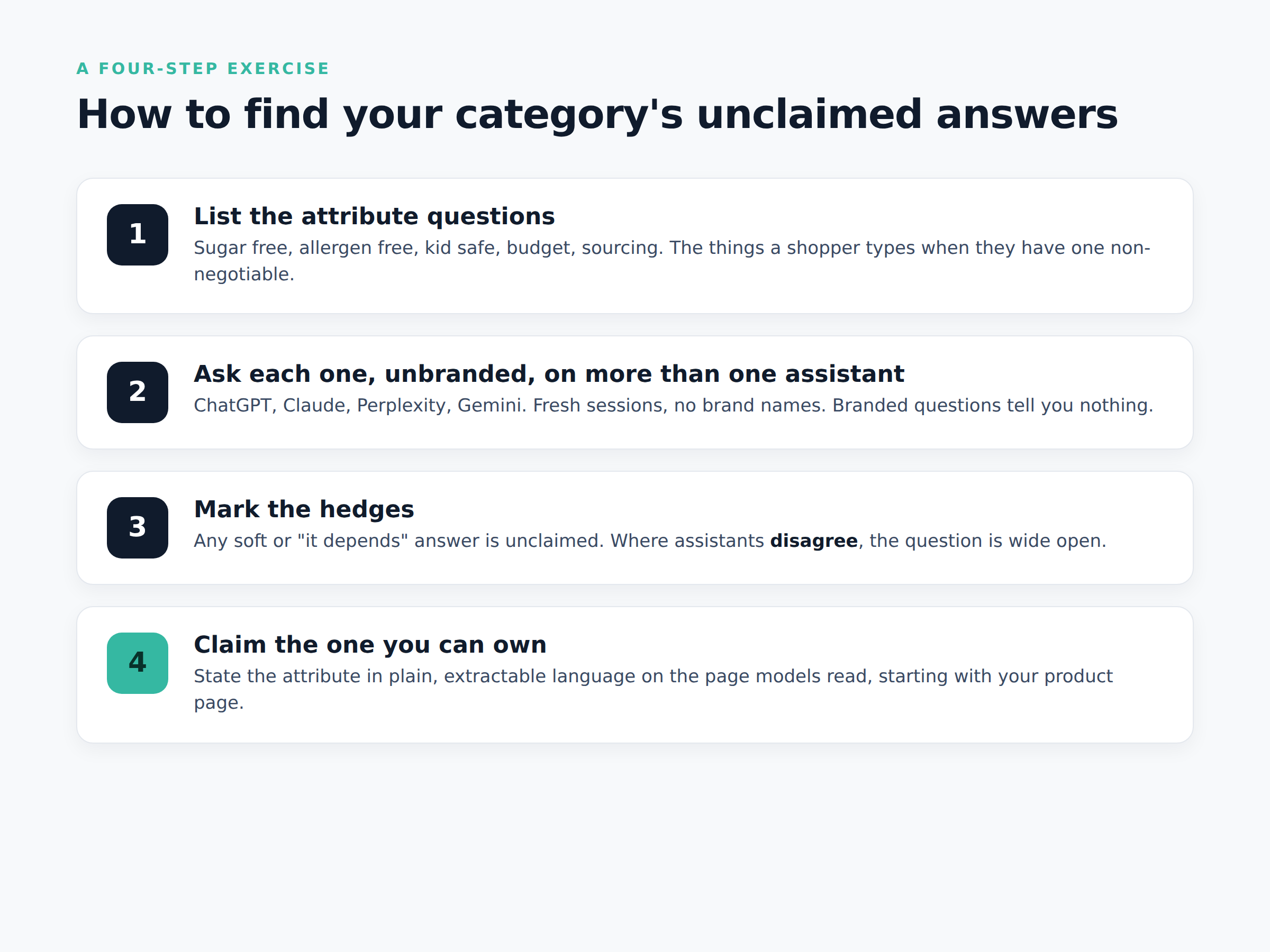
1. List the attribute questions a real buyer would ask. Sugar free, allergen free, kid safe, budget, sourcing, sweetener, ingredient avoidances. Aim for the things a shopper types when they have one non-negotiable.
2. Ask each one across more than one assistant, unbranded, in a fresh session. Use ChatGPT, Claude, Perplexity, and Gemini with no memory or custom instructions polluting the result. Never ask about your own brand by name; a branded question almost always returns a flattering answer and tells you nothing about whether you get recommended.
3. Mark the hedges. Any question that gets a soft, low-confidence, or "it depends" answer is an unclaimed answer. That is your target list. Where different assistants disagree, the question is even more open, and that disagreement is the real window, because the models have not settled on a winner everywhere yet.
4. Claim the one you can actually own. Pick a question your product genuinely satisfies, then state that attribute in plain, specific, extractable language on the page the models read, starting with your own product page. Do not bury it in a PDF or a hero graphic. Write the sentence a model can quote.
See which answers are unclaimed in your category
The free AI Shelf Snapshot tests your brand and your category on real buyer questions across more than one assistant, and scores where you appear, where you are only eligible, and which answers are still sitting unclaimed. The full AI Visibility Audit scores 20 to 30 questions across ChatGPT, Claude, Perplexity, and Gemini and turns the results into a sequenced, page-by-page fix roadmap your team can run.
FAQ: unclaimed answers and AI visibility
What is an unclaimed answer in AI search?
An unclaimed answer in AI search is a specific buyer question where the AI assistant has no confident brand to recommend, so it hedges or guesses. These are usually attribute questions one layer below the main category question, like "no stevia" or "safe for kids," and they are the cheapest questions for a brand to win because no competitor has claimed them yet.
Why do big brands lose narrow attribute questions?
Big brands lose narrow attribute questions because category leadership does not transfer question by question. An assistant scores each question on whether a brand has clearly stated the specific attribute being asked about, not on overall fame. A category leader whose product does not fit the attribute, or who never published the claim in extractable language, can be named as the wrong choice while a smaller brand wins.
What does "eligibility is not visibility" mean?
It means a product can genuinely qualify as the right answer and still never be recommended, because nothing it published told the AI so. AI assistants build answers from content they can read and cite. If your qualifying attribute is not stated in plain, specific language on a page the models read, you remain invisible on that question no matter how well your product actually fits.
How do I find the unclaimed answers in my category?
List the attribute questions real buyers ask, then ask each one, unbranded, across several AI assistants in fresh sessions. Any question that returns a hedged or low-confidence answer is unclaimed and available. Questions where assistants disagree are the most open of all.
How do I claim an AI answer once I find it?
State the qualifying attribute in plain, specific, extractable language on the pages models actually read, starting with your own product pages. The goal is a sentence an assistant can lift directly, such as a clear statement of your sweetener system or ingredient profile, rather than a claim hidden in a graphic or a downloadable PDF.