The AI Shelf: Who Wins When Shoppers Ask AI What to Buy
The AI shelf is the short list of brands an AI assistant actually names when a shopper asks what to buy. In our August 2026 test of the prebiotic soda category, 10 real shopper questions produced answers dominated by just two brands, and the most valuable answers went to whichever brand had published its facts in plain, machine-readable language on the sources the models read.
On a retail shelf, a shopper standing in the aisle sees 8 to 12 brands in a category. When that same shopper asks ChatGPT or Claude "what's the best prebiotic soda," the answer usually contains two or three. If your brand is not one of them, you were never considered. There is no second facing, no eye-level slot, no endcap. There is the answer, and everyone else.
To see how this plays out in a real category, we ran a simple test in August 2026: ten questions, phrased the way real shoppers ask them, put to AI assistants cold, with no brand context. We picked prebiotic soda because it is the perfect AI shelf story. Olipop and Poppi are no longer challengers; Olipop was valued at $1.85 billion in its February 2026 round and Poppi was acquired by PepsiCo. Every independent brand in the category is fighting billion-dollar incumbents for retail shelf space. The question was whether the same fight is happening on the AI shelf.
It is, and it is more lopsided.
How we tested AI prebiotic soda recommendations: 10 real shopper questions
We did not ask marketer questions like "top prebiotic soda brands 2026." We asked shopper questions:
- What's the best prebiotic soda?
- I'm trying to quit Diet Coke. What's a healthier soda I should switch to?
- Olipop vs Poppi: which one is actually better for gut health?
- Which prebiotic soda has the least sugar?
- What's a good healthier soda option for my kids?
- What gut-healthy drinks should I pick up at Whole Foods?
- Are prebiotic sodas actually good for you? Which ones are worth buying?
- What are some good prebiotic sodas besides Olipop and Poppi?
- Is there a prebiotic soda that doesn't use stevia?
- Prebiotic sodas are expensive. Is there a cheaper one that still tastes good?
The full set ran on Claude with web search, each question in a fresh session with no memory. The highest-stakes questions were then verified on ChatGPT, logged out, with screenshots. Where the two assistants disagreed, we say so below, because the disagreement turned out to be one of the findings.
Finding 1: Olipop and Poppi dominate AI recommendations for prebiotic soda
In 9 of the 10 questions, the answer started and mostly ended with Olipop and Poppi. Here is the scorecard:
| Brand | Named (of 10 answers) | First recommendation |
|---|---|---|
| Olipop | 8 | 6 |
| Poppi | 7 | 0 |
| Four independent challengers (combined) | 1 to 3 each | 0 |
Question 2 is the one that should worry every challenger brand. "I'm trying to quit Diet Coke" is the category's single biggest switching moment, the exact shopper every functional soda brand spends money to reach. ChatGPT's answer named sparkling water, then Olipop and Poppi as the only prebiotic sodas, then Zevia and kombucha. At the moment a new customer enters the category, the AI shelf holds two brands.
Finding 2: Challenger soda brands are invisible in unbranded AI answers
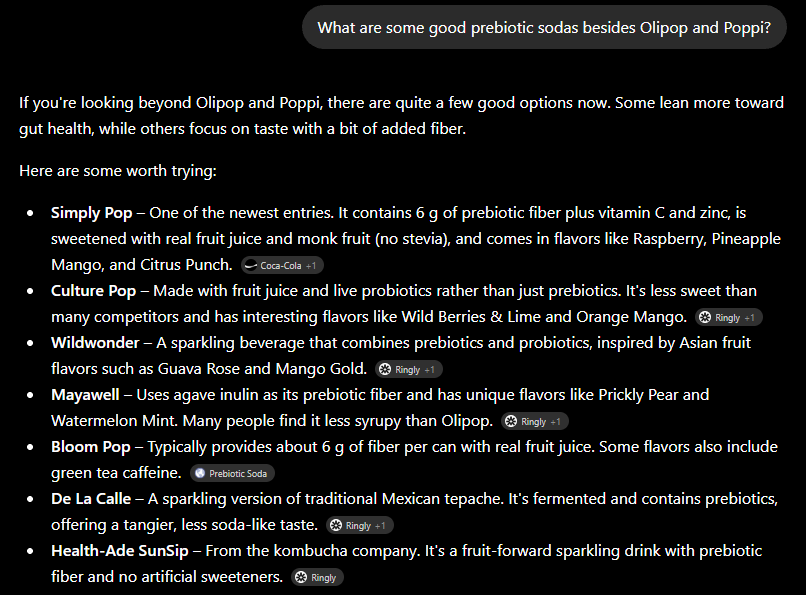
There was one question where the independent brands all showed up: question 8, "what are some good prebiotic sodas besides Olipop and Poppi." That phrasing does the brands' work for them. It requires a shopper who already knows the category leaders by name and already knows alternatives exist.
New-to-category shoppers never phrase it that way. Which means for most real shoppers, the challengers are not losing the AI shelf. They are simply not on it.
And even that "alternatives" answer is being captured. When we verified question 8 on ChatGPT, the list of alternatives was led by Simply Pop, which is Coca-Cola's entry into the category, with Health-Ade's SunSip also placing in the general answer. The independents were competing for the slots below big-company entries inside the one question that was supposed to be theirs.
Finding 3: How Simply Pop took over ChatGPT's no-stevia prebiotic soda answer
Here is the single most useful artifact from the whole test.
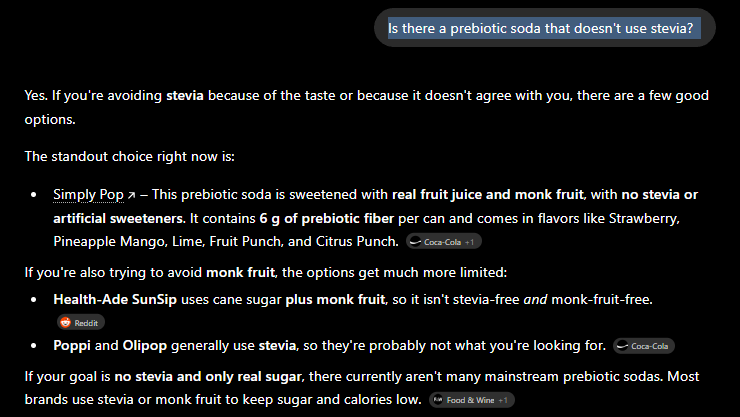
Question 9 asks for a prebiotic soda that does not use stevia. When we first ran it in early August, the answer was hedged and low-confidence. Two days later, ChatGPT's answer opened with "Yes," named Simply Pop as the standout choice, cited its real fruit juice, monk fruit sweetening, and 6 grams of prebiotic fiber, and then explicitly disqualified the category leaders: Olipop and Poppi "generally use stevia, so they're probably not what you're looking for."
Look at what the model cited to build that answer: Coca-Cola's own product pages, twice, plus Reddit and Food & Wine.
Coca-Cola did not win that answer with ad spend. It won it by publishing the attribute, in plain and machine-readable language, on pages the model reads. Meanwhile, brands that plausibly qualify on formulation were absent from the answer, because nothing legible told the model they qualified.
Three lessons hang off this one example:
1. Category leadership does not transfer to attribute questions. Olipop and Poppi own "best prebiotic soda" and get named as the wrong choice on the stevia question. AI visibility is not one score. It has to be measured question by question.
2. Eligibility is not visibility. Qualifying on the shelf means nothing if the sources the model reads never say so. What you publish decides which one you are.
3. The answers are not settled yet. On the same question, in the same week, Claude hedged where ChatGPT was definitive. Different assistants read different sources and reach different verdicts, which means unclaimed and weakly-held answers still exist. That is the honest version of the urgency argument: the window is real, and it is closing as major CPGs start publishing for the machines on purpose.
What AI visibility means for challenger CPG brands
The uncomfortable part first: you probably do not have an awareness problem. In our testing across categories, the models almost always know the brand. Founding story, ingredients, retail placement, all of it. What you have is a publishing problem: nothing you control lives in the sources assistants read when nobody types your brand name.
The practical to-do list that falls out of a test like this is specific:
1. Find your questions. Learn which questions in your category you appear in today, and which ones you should own and don't. Attribute questions (no stevia, no seed oils, safe for kids, lowest sugar) are usually the cheapest wins.
2. Map the sources. Each assistant builds its answers from a findable list of editorial roundups, retailer guides, community threads, and brand pages. Which list, for which question, is knowable. That map turns AI visibility from a mystery into a publishing plan.
3. Publish the way the winner did. State your qualifying attributes in plain, specific, extractable language on pages the models actually read, starting with your own product pages.
Test your brand's AI visibility with a free AI Shelf Snapshot
We run this exact test for mid-market consumer brands as the free AI Shelf Snapshot: your brand and your category, tested on real buyer questions, with a scorecard of where you appear, where you don't, and who is winning the answers instead. If you want the full map, the AI Visibility Audit scores 20 to 30 questions across ChatGPT, Claude, Perplexity, and Gemini and turns the results into a sequenced, page-by-page fix roadmap your team can run.
When shoppers ask AI what to buy, someone is the answer. The rest of this year decides whether it's you.
FAQ: AI visibility for consumer brands
What is the AI shelf?
The AI shelf is the set of brands an AI assistant names when a shopper asks what to buy in a category. Unlike a retail shelf that displays 8 to 12 brands, an AI answer typically recommends only two or three, so brands are either in the answer or invisible to that shopper.
How do I find out if my brand shows up in AI recommendations?
The reliable way to check your brand's AI visibility is to ask the assistants the way shoppers do: unbranded category questions ("best X," "healthiest X," "X without stevia") in fresh sessions with no memory, across more than one assistant. Branded questions ("tell me about [your brand]") will almost always return a good answer and tell you nothing about whether you get recommended. Shelf Help AI runs this test as a free AI Shelf Snapshot for mid-market consumer brands.
Why do AI assistants recommend some brands and not others?
AI assistants build shopping answers from a specific set of sources they read and trust: editorial roundups, retailer guides, community threads like Reddit, and brand product pages. Brands that appear in those sources, with clear and extractable claims, get named. Brands that qualify on the shelf but are absent from those sources get skipped, which is why heavy PR or strong retail placement often fails to show up in AI answers.
Is AI visibility the same as SEO?
AI visibility (sometimes called AEO or GEO) shares bones with SEO but has a different reader and a different win condition. SEO wants a human to click a ranked link; AI visibility wants the model to name your brand inside its answer, where there may be no link to click. Content that never ranked on Google, like a niche comparison post or a community thread, can still decide an AI answer, so the work is mapped and prioritized differently.